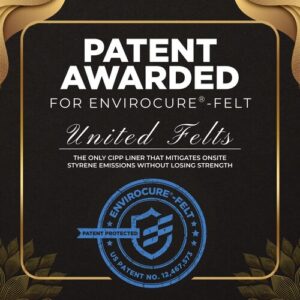
The United States Patent and Trademark Office (USPTO) has issued U.S. Patent No. 12,467,573 to United Felts, a subsidiary of Vortex Companies, for its EnviroCure®-Felt technology. The patent protects a specific construction of cured-in-place pipe (CIPP) liners that incorporates a styrene-impermeable polymer barrier. This technical advancement is designed to encapsulate styrene resin during the curing process, addressing long-standing environmental and occupational safety concerns regarding volatile organic compound (VOC) emissions in trenchless infrastructure projects.
The technical substance of the patent focuses on the material chemistry and layering of the CIPP liner. Traditional CIPP methods often involve the use of thermosetting resins containing styrene, which can migrate into the surrounding environment or atmosphere during steam or hot water maturation. The EnviroCure-Felt system utilizes an integrated barrier film that functions as a containment layer. According to technical specifications provided by the manufacturer, this barrier reduces styrene emissions to levels below 1 part per million (ppm). This is a significant threshold for regulatory compliance, as it sits substantially below standard industry averages for open-system emissions.
For legal professionals and regulatory specialists, this patent marks a shift in the risk management landscape of municipal and industrial pipeline restoration. The development of specialized coatings and adhesive membranes that retain chemical integrity without compromising structural load-bearing capacity is central to modern product liability mitigation. By effectively sequestered the styrene monomers within the liner matrix, the technology seeks to limit potential litigation related to community odor complaints and worker exposure claims, which have historically complicated CIPP adoption in densely populated urban corridors.
Furthermore, the technology serves as a bridge between traditional styrene-based resins and more expensive styrene-free alternatives. While styrene-free resins exist, they often present different mechanical properties and higher procurement costs. The patented barrier technology allows for the continued use of established chemical formulations while meeting increasingly stringent municipal air quality standards. From an intellectual property perspective, the issuance of this patent underscores the competitive landscape for “low-emission” infrastructure materials and may signal a trend toward more rigorous materials specifications in public works contracts.
For practitioners advising clients in the construction, utility, and civil engineering sectors, the patenting of this encapsulation technology highlights the intersection of IP protection and environmental compliance. As regulatory bodies like the EPA and OSHA continue to evaluate styrene limits, the existence of patented mitigation technologies may influence future “Best Available Technology” (BAT) determinations. Practitioners should note that while this technology addresses emission concerns, the installation maintains compatibility with standard industry equipment, reducing the likelihood of procedural errors that can lead to breach of contract or performance disputes in the field.
This article was generated or assisted by artificial intelligence and has been reviewed for accuracy; however, AI-generated content may contain errors or omissions. This article is provided by Innov8 Chem LLC and its subsidiaries for informational purposes only. The content herein does not constitute legal, technical, or professional advice and should not be relied upon as such. This publication is not intended to endorse, promote, disparage, or harm any company, product, or service mentioned. Readers should consult qualified legal and technical professionals before making any decisions based on the information presented. Innov8 Chem LLC and its subsidiaries disclaim all liability arising from the use of or reliance on this content.