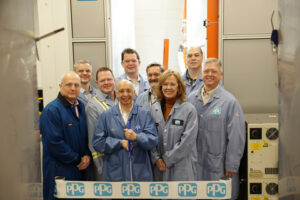
 PPG Industries announced the deployment of a pilot finishing line incorporating IPG Photonics’ PhotoniCURE™ fiber laser curing system at a powder manufacturing and technical facility in Strongsville, Ohio, together with a laboratory-scale system at PPG’s Coatings Innovation Center near Pittsburgh. The program includes pilot trials with Whirlpool Corporation focused on applying and curing powder coatings on appliance components, with the aim of assessing cycle times, energy consumption, and coating performance under production-representative conditions.
Technically, the PhotoniCURE system applies concentrated infrared (IR) radiation from fiber lasers to initiate polymer crosslinking in powder coatings. Reported distinctions from convective thermal ovens include markedly reduced cure times—on the order of minutes per part rather than tens of minutes—and lower bulk thermal loading of substrates. The process is stated to be compatible with both conventional polymer-based powder chemistries and formulations optimized for laser absorption; cure kinetics, crosslink density, and film formation are cited as endpoints under evaluation. Operational variables noted for testing include laser power density, scan strategy, dwell time, conveyor speed, and the resulting cure window and adhesion metrics across differing substrate geometries and finish thicknesses.
Manufacturing implications described in the announcement relate to line integration and materials handling. Laser curing may permit reduced oven length and lower set-point temperatures, which could be consequential for throughput (parts per hour), energy intensity (kWh per unit coated), and thermal exposure of heat-sensitive Plastics and other substrates. Powder application and bonding capabilities—PPG cites a global powder footprint including multiple production sites and bonding lines—may be relevant to scale-up. Powder chemistries referenced include recycled polyethylene terephthalate (rPET)-containing and PFAS-free formulations; the interaction of those resin systems with focused IR curing and the effect on long-term performance parameters such as corrosion resistance and edge coverage are identified as empirical questions for the pilot program.
From a compliance and legal perspective, the technology and program features outlined may be pertinent to several areas. Intellectual property considerations may include patents or trade secrets covering laser system hardware, beam delivery and scan algorithms, coating formulations tailored for IR absorption, and process integration methods; the PhotoniCURE mark is identified as an IPG trademark. Regulatory and standards issues that may be implicated include occupational laser safety standards, combustible dust and powder handling regulations, and chemical substance regulations relating to PFAS and recycled content; referenced examples include ANSI, NFPA and ATEX/NEC frameworks though applicable regimes may vary by jurisdiction. Product performance and warranty matters may be affected by altered cure profiles and substrate heating, which may have downstream relevance for product liability and quality-control practices.
For attorneys, patent professionals and regulatory compliance specialists monitoring industrial finishing, the pilot program may warrant consideration for topics such as process patents, licensing arrangements, materials specifications, manufacturing safety protocols and regulatory reporting tied to chemical composition and energy use. The outcomes from the pilot trials may inform contractual terms, testing requirements, and supply-chain specifications where laser-based curing is adopted at scale.
Disclaimer: This article was generated or assisted by artificial intelligence and has been reviewed for accuracy; however, AI-generated content may contain errors or omissions. This article is provided by Innov8 Chem LLC and its subsidiaries for informational purposes only. The content herein does not constitute legal, technical, or professional advice and should not be relied upon as such. This publication is not intended to endorse, promote, disparage, or harm any company, product, or service mentioned. Readers should consult qualified legal and technical professionals before making any decisions based on the information presented. Innov8 Chem LLC and its subsidiaries disclaim all liability arising from the use of or reliance on this content.