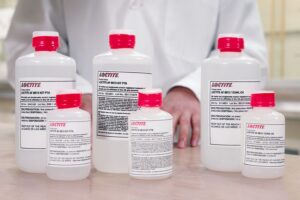
Henkel announced a two‑product portfolio of anti‑fingerprint (AF) coatings targeted at in‑vehicle displays and touchscreens, formulated without per‑ and polyfluoroalkyl substances (PFAS) or other fluorine‑containing ingredients. The products—Loctite AF 8810, aimed at plastic display cover lenses, and Loctite AF 8812, described by the company as meeting a 9H hardness standard on glass—are based on a silicone‑derived, low‑surface‑energy chemistry intended to balance oleophobicity, hydrophobicity and optical clarity.
From a materials and process standpoint, the formulations are reported to deliver low coefficient of friction for touch interactions while maintaining high optical transmission and minimal haze, properties commonly specified in display optics. Henkel describes AF 8812 as retaining consistent water contact angles after 5,000 eraser‑type abrasion cycles and as preserving hydrophobic character following extended UV exposure. Application methods noted by the company include conventional spray deposition and physical vapor deposition (PVD) processes, with cure schedules cited as short as 30 minutes under heat, indicating potential compatibility with high‑throughput automotive assembly lines and existing coating stations.
Manufacturing integration considerations may include substrate adhesion and surface preparation protocols for both polycarbonate or other plastics and glass, crosslinking chemistry and cure energy, and coating thickness controls to preserve optical properties. The absence of PFAS and fluorine in the disclosed formulations may alter chemical resistance and wetting behavior relative to fluorinated coatings; validation data and third‑party analytical confirmation may inform material specifications and incoming inspection criteria. Process controls such as ambient and oven temperatures, cure time, and deposition uniformity may also bear on long‑term abrasion resistance and appearance retention.

Aspects of intellectual property and supply chain disclosure may be implicated by new commercial formulations. The company branding under Loctite suggests continuity with existing Adhesives and Coatings product lines in automotive markets, and the new chemistry may be subject to proprietary trade‑secret protection and/or patent filings. Freedom‑to‑operate analyses and patent landscaping may be relevant to manufacturers and suppliers evaluating adoption, and specification language in contracts may be adjusted to address formulation ownership and know‑how transfer.
Regulatory and compliance context for downstream manufacturers may include evolving PFAS restrictions across jurisdictions, including regulatory frameworks in Europe, the United States and parts of Asia. Material declarations, restricted‑substances lists, and verification testing protocols—potentially involving targeted PFAS assays or total fluorine screening—may be factors in qualifying coatings for series production. Product‑performance claims tied to durability and hardness metrics may intersect with warranty language and aftermarket expectations; documentation of test methods and acceptance criteria may be useful in commercial agreements.
For legal and technical practitioners advising OEMs, tier‑suppliers or materials vendors, the announcement may be relevant to considerations of materials specification, regulatory conformity, IP positioning and product‑performance documentation. Further details on formulation data sheets, independent testing protocols and supply‑chain traceability may be sought to assess fit with manufacturing, compliance and commercial risk frameworks.
Disclaimer: This article was generated or assisted by artificial intelligence and has been reviewed for accuracy; however, AI-generated content may contain errors or omissions. This article is provided by Innov8 Chem LLC and its subsidiaries for informational purposes only. The content herein does not constitute legal, technical, or professional advice and should not be relied upon as such. This publication is not intended to endorse, promote, disparage, or harm any company, product, or service mentioned. Readers should consult qualified legal and technical professionals before making any decisions based on the information presented. Innov8 Chem LLC and its subsidiaries disclaim all liability arising from the use of or reliance on this content.